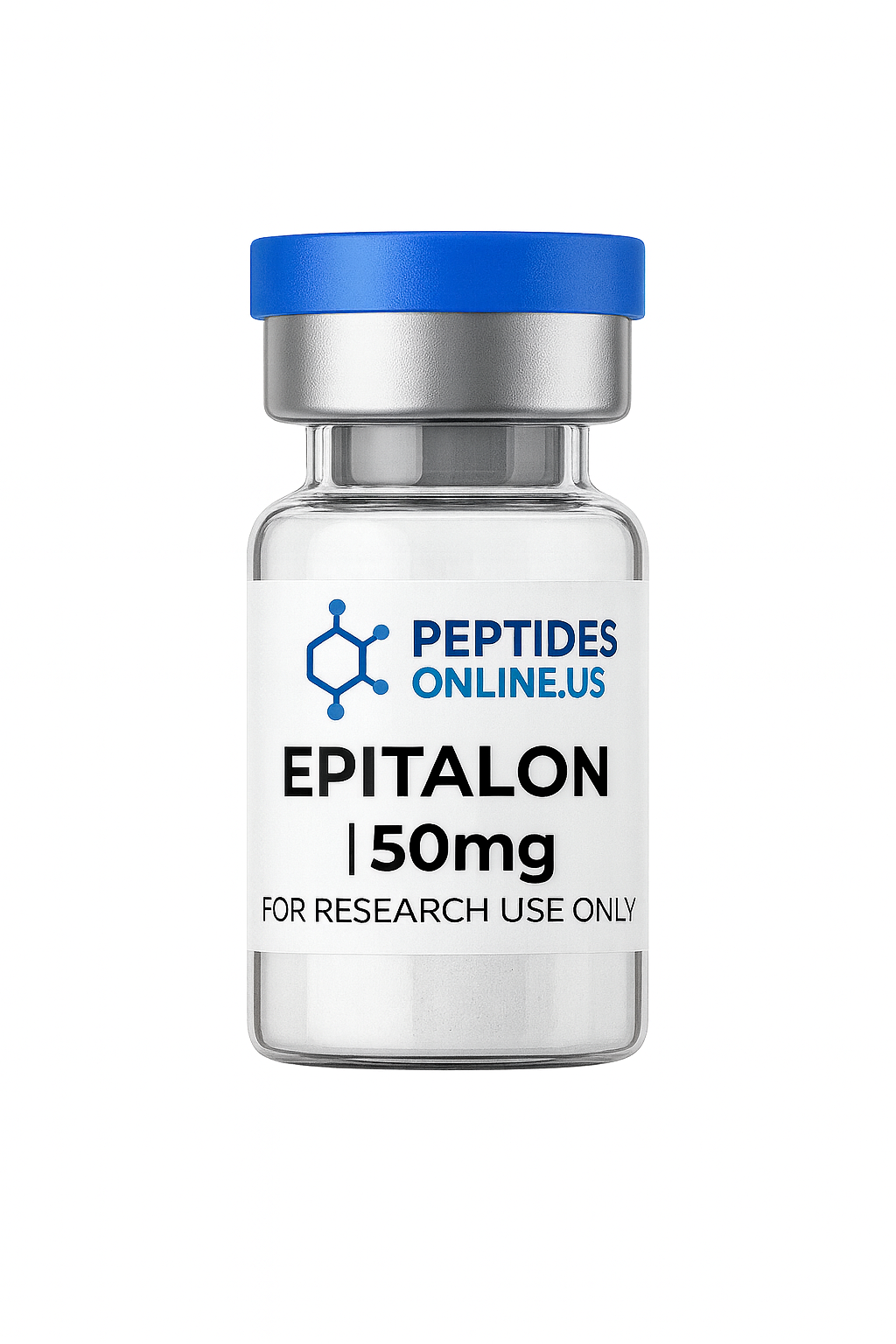
Original price was: $250.00.$119.99Current price is: $119.99.
CAS No.: 307297-39-8
Molecular Weight: 902.85 g/mol
Epitalon (also called Epithalon) is investigated for cell-aging research, including studies on telomerase activity and gene-expression programs in cell and animal models.
References: https://pubmed.ncbi.nlm.nih.gov/12937682/ ; https://pmc.ncbi.nlm.nih.gov/articles/PMC7037223/
For research use only. Not for human consumption or veterinary use.
Epitalon is a synthetic tetrapeptide identified by Dr. Vladimir Khavinson in the 1980s during studies on pineal gland extracts. Researchers found that this pineal gland peptide could influence telomerase activity under controlled laboratory conditions. Its four-amino acid sequence has become the focus of global peptide research.
Epitalon appears to play a role in maintaining telomere length and regulating circadian rhythms in experimental models. Current laboratory research continues to explore how this synthetic peptide affects cellular aging, melatonin production, and oxidative balance, making it a notable compound in molecular longevity studies.
What is Epitalon? It is a synthetic peptide derived from research on pineal gland extracts. This compound, made of four amino acids—alanine, glutamic acid, aspartic acid, and glycine—was developed to study its biological effects under controlled laboratory conditions. [1]
Researchers examine how it influences cellular health, circadian rhythms, and the aging process. Epitalon serves as a valuable model for understanding how peptide regulation affects gene activity and cell stability. Its consistent molecular behavior makes it an important focus in experimental studies on biological aging.
Epitalon peptide was discovered in the 1980s by Dr. Vladimir Khavinson during research on pineal gland extracts in St. Petersburg, Russia. [2] It was synthesized as a purified version of the natural peptide Epithalamin to allow consistent laboratory testing. Researchers aimed to study its role in cellular aging and pineal gland function.
Early studies found that Epitalon increased telomerase activity under controlled conditions. Over time, global research expanded its scope, examining its role in circadian rhythm regulation, cellular stability, and oxidative balance.
Epitalon peptides interact with cellular systems by influencing gene expression and enzyme activity, mechanisms that are also fundamental to human cells. Under controlled laboratory conditions, researchers observed that it supports telomerase activation, helping maintain telomere length during cell division. The peptide also affects melatonin synthesis by modulating pineal gland function.
Studies report that Epitalon decreased oxidative stress markers and improved mitochondrial performance. It appears to regulate circadian rhythms and cell signaling involved in apoptosis and regeneration. These findings suggest a direct influence on maintaining balanced cellular processes and overall molecular stability.
Epitalon’s molecular structure gives it stability and precision in laboratory research. This tetrapeptide contains four amino acids that determine its molecular behavior and reactivity in aqueous solutions.
Its small size and purity allow predictable peptide behavior in experimental studies exploring telomere elongation, circadian rhythm regulation, and cellular stability.

Epitalon was synthesized as a shorter analog of the natural pineal peptide Epithalamin. Both share similar amino acid sequences but differ in purity and molecular uniformity. [3] Researchers developed Epitalon to replicate Epithalamin’s biological characteristics in a more controlled and consistent form.
Under laboratory conditions, both peptides influence melatonin production, telomerase activity, and circadian rhythm regulation. The discovery of Epithalamin guided Epitalon’s creation, forming the foundation for advanced studies on cellular aging and pineal gland function.
Epitalon is supplied as a lyophilized (freeze-dried) powder, preferred for stability and precision in laboratory research. This format preserves molecular integrity and extends shelf life under proper storage. Purity is verified using high-performance liquid chromatography and mass spectrometry. These methods confirm molecular identity and detect impurities.
Maintaining purity levels of ≥99% ensures reliable experimental outcomes. Proper handling, sealed containment, and controlled temperature conditions help preserve Epitalon’s bioactivity and prevent cross-contamination during analytical testing and reconstitution.
Scientific studies on Epitalon focus on its molecular effects under controlled laboratory conditions. Researchers examine how it influences telomerase activation, pineal gland function, and cellular longevity within the expanding field of peptide therapy.
Additional investigations explore its relationship with DNA protection, oxidative balance, and circadian rhythm regulation. These findings help expand understanding of peptide behavior in biological aging and molecular stability research, supporting continued interest in its potential health benefits.
Researchers study the peptide Epitalon for its effects on telomerase enzyme activity. Under controlled conditions, Epitalon increased telomerase expression, helping preserve telomere length—the chromosome’s protective caps—during cell replication.
Scientists use molecular markers to measure this response and assess its link to cellular longevity. Aging-related studies supported by institutions like the Alzheimer’s Drug Discovery Foundation highlight the ongoing academic interest in the peptide Epitalon and its relevance to telomerase research.
Findings suggest that Epitalon supports chromosomal stability and delays cellular senescence. These results highlight its importance in aging-related research focused on understanding telomerase regulation and the mechanisms of biological aging at the cellular level. [4]
Epitalon interacts directly with the pineal gland, a structure that regulates circadian rhythms and hormone release. Researchers observed that Epitalon modulates melatonin synthesis and supports pineal gland function in aging models. [5] The peptide influences endocrine signaling linked to biological timing and metabolic regulation.
Studies also show that Epitalon helps preserve pineal tissue structure and responsiveness. These findings emphasize its importance in understanding how peptide regulation affects circadian and hormonal balance within biological systems.
Epitalon has been examined for its potential role in maintaining DNA stability. Researchers report that it supports chromatin structure [6] and enhances the activity of repair enzymes involved in genome protection, a response also observed in bone marrow cells exposed to Epitalon under experimental conditions. The peptide helps maintain normal gene expression patterns associated with cellular longevity.
Experimental findings suggest that Epitalon reduces chromosome aberrations and slows cellular senescence markers. These outcomes provide valuable insights into how peptides contribute to DNA preservation and long-term cellular health.
Epitalon has been studied for its influence on skin cell renewal and structural integrity in laboratory research. In an in vitro study, researchers observed that it enhances fibroblast activity and stimulates collagen-related activity. [7] These actions help maintain extracellular matrix organization and support skin elasticity.
The peptide also affects gene expression related to collagen and elastin production. Studies indicate that Epitalon contributes to understanding how peptides influence tissue regeneration and age-related changes in skin cell biology.
Scientists have also investigated how Epitalon influences cell growth regulation and tissue repair. Comparisons between Epitalon-treated models and control groups indicate that it modulates apoptosis and cell cycle progression, helping maintain proper cellular balance.
Some laboratory studies also explore its relevance in cancer prevention research, focusing on how peptide regulation may affect abnormal cell proliferation. Changes in tumor suppressor and oncogene expression, along with variations in spontaneous tumor incidence, linked to Epitalon exposure have been observed. [8]
Experimental findings suggest this peptide appears to assist in cellular recovery processes following DNA or oxidative stress. These insights contribute to understanding molecular pathways involved in controlled regeneration and cellular repair mechanisms.
Epitalon has also been examined for its effects on melatonin synthesis and secretion. [9] Researchers observed that it interacts with the pineal gland to regulate hormonal signals linked to circadian rhythms. The peptide influences daily fluctuations in melatonin levels and supports rhythmic stability in experimental models.
Findings show that Epitalon supports normal sleep-wake rhythm patterns. These results make it valuable in studying how peptides contribute to endocrine balance and biological rhythm regulation.
Epitalon has been evaluated for its effects on retinal cell activity and eye tissue function in experimental models. Researchers found that it supports photoreceptor stability and regulates pigment epithelium activity. The peptide helps maintain retinal metabolism and cellular communication in visual pathways. [10]
Studies report improved structural integrity in aging retinal tissue. These findings highlight Epitalon’s significance in research exploring peptide involvement in ocular cell protection and visual system maintenance.
Epitalon also exhibits promising properties in oxidative balance and immune system regulation. Researchers observed that it enhances antioxidant enzyme activity, including superoxide dismutase and catalase, contributing to a more stable immune response in experimental conditions. The peptide reduces reactive oxygen species accumulation and supports mitochondrial efficiency.
Experimental models suggest improved immune function and cellular resilience after Epitalon exposure. These findings indicate that Epitalon contributes to understanding how peptides promote energy stability, oxidative stress control, and systemic balance at the cellular level in controlled research environments.
Epitalon undergoes strict laboratory testing to confirm purity and molecular identity. Each batch is analyzed using validated methods to guarantee consistency and accuracy. Testing ensures that every vial meets research-grade standards before distribution. Certificates of Analysis verify quality control, giving laboratories reliable data for experimental reproducibility and scientific integrity in peptide-based research.
A Certificate of Analysis (COA) confirms the quality, purity, and molecular identity of each Epitalon batch. Laboratories use the COA to verify data such as peptide purity, molecular weight, and sequence accuracy. Analytical techniques like HPLC and mass spectrometry provide this information. These tests ensure transparency and reproducibility in peptide research.
Peptides Online includes a COA with every Epitalon 10mg vial, confirming compliance with research-grade standards for precision, safety, and reliability in experimental use. Only buy Epitalon with a complete and verified COA.
Analytical testing verifies the purity and molecular identity of Epitalon using high-performance liquid chromatography, mass spectrometry, and nuclear magnetic resonance. These methods confirm that the peptide contains no residual solvents or synthesis byproducts. Identity verification ensures the correct amino acid sequence and molecular structure.
Laboratories rely on ≥99% purity for consistent results. Independent third-party testing supports transparency and authenticity, providing researchers with assurance of quality when obtaining Epitalon for scientific use.
Proper handling and storage are essential for maintaining Epitalon’s molecular integrity. The peptide should remain in a cool, dry environment protected from light and moisture. Fluctuating temperatures can affect stability and reduce research accuracy. Laboratories typically store sealed vials with desiccants to prevent contamination.
Refrigeration or freezing supports long-term preservation. Accurate labeling, inventory tracking, and environmental monitoring ensure product traceability and consistent quality throughout its use in controlled scientific research settings.
Epitalon remains stable in its lyophilized form when stored under proper conditions. Before research use, it is reconstituted with sterile, pH-balanced diluents such as bacteriostatic water. This helps preserve peptide integrity and prevents degradation.
Researchers maintain a controlled temperature during reconstitution to protect molecular structure. Once mixed, the solution should be used promptly or stored at low temperature for short-term stability. Visual inspection ensures clarity and consistency. These steps maintain experimental accuracy and ensure reliable results during peptide-based laboratory studies.
Epitalon Peptide (10mg) is intended strictly for laboratory research purposes. It is not approved for human, veterinary, or diagnostic use. This product should only be handled by qualified professionals in controlled environments following proper safety protocols. The information provided here is for scientific and educational reference only. It must not be interpreted as medical, therapeutic, or legal advice. All details are presented to support transparency, accuracy, and responsible research practices. Laboratories should use Epitalon Peptide (10mg) solely within approved research guidelines and compliance frameworks.