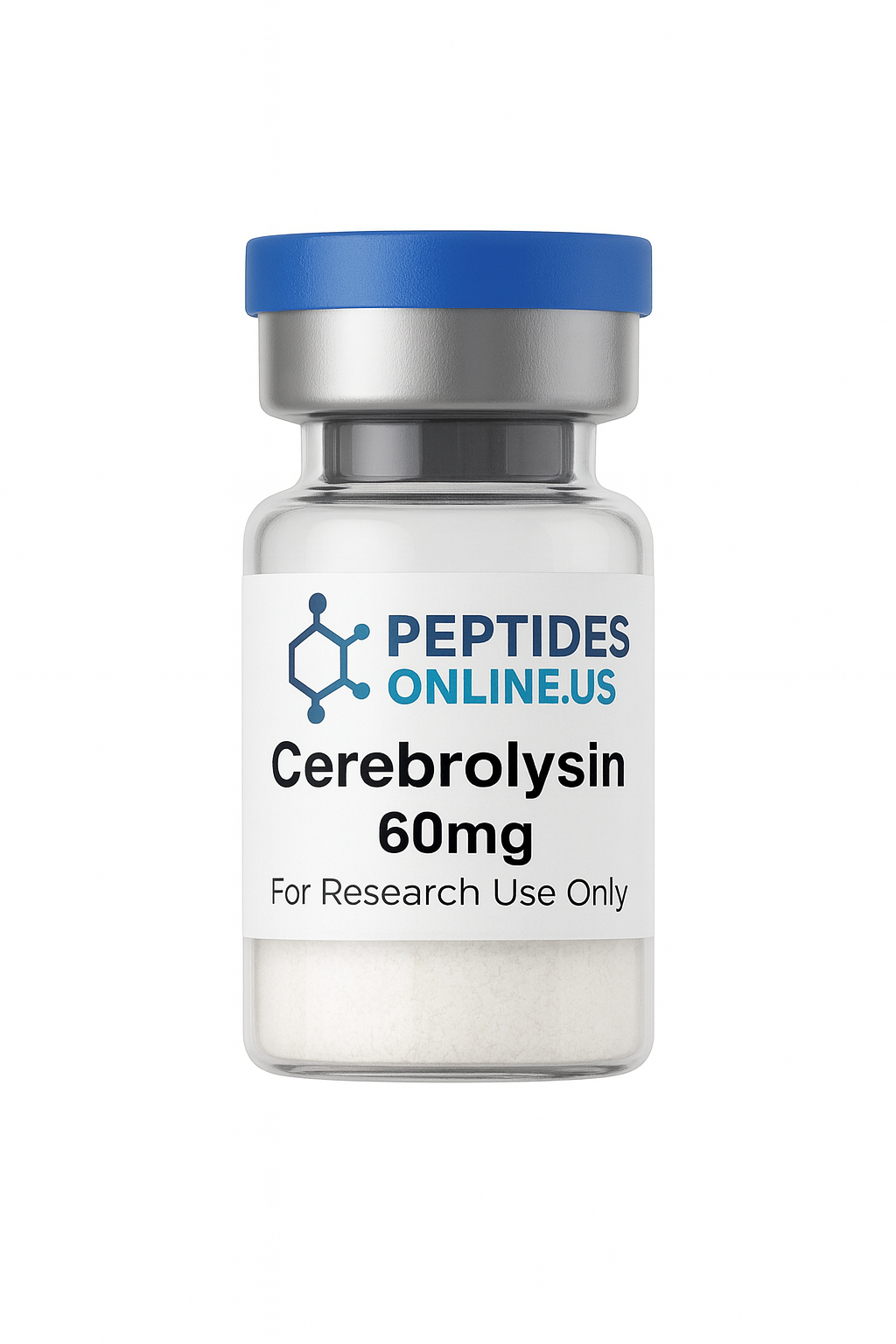
Original price was: $90.00.$44.99Current price is: $44.99.
CAS no.: 12656-61-0
Molecular Weight: Variable (Peptide mixture)
Cerebrolysin is a peptide-based mixture that has been studied in neuroscience research for its potential protective effects on the brain and nervous system. Scientific investigations have explored its possible role in supporting recovery after stroke, as well as in research on conditions linked to neurodegeneration and cognitive decline.
Studies have examined how Cerebrolysin might influence brain cell survival, repair mechanisms, and communication between neurons. Research has also considered its potential impact on memory, learning, and overall cognitive function. Results across studies and reviews have been mixed, with findings varying depending on the models and methods used.
This product is provided strictly for laboratory research. It is not intended for human or animal use.
Sources: https://pubmed.ncbi.nlm.nih.gov/29430901/, https://pubmed.ncbi.nlm.nih.gov/22999264/
More than fifty years ago in Austria, scientists created Cerebrolysin to help researchers study how brain-derived peptides affect neuronal activity and survival. They found that it has a unique composition — a balanced mix of short-chain peptides and amino acids that are similar to the natural neurotrophic factors in the human brain.
Today, this peptide remains an important reference compound in studies of neuroplasticity, synaptic signaling, and cellular restoration. Its standardized formulation ensures consistent peptide concentration and reproducible research results, making it a reliable material for studying neuronal growth, function, and repair.
What is Cerebrolysin? It is a peptide-based preparation first developed in the 1950s by scientists at EVER Neuro Pharma GmbH in Austria. [1] The goal was to investigate how brain-derived peptides influence neuronal repair and communication. Researchers extracted and purified bioactive peptides from pig brains (porcine brain tissue) to create a stable formulation that mimics natural neurotrophic factors.
Over the decades, cerebrolysin has been studied extensively in laboratory settings exploring cognitive function, neuroplasticity, and cellular metabolism. Researchers often describe it as a multimodal drug due to its diverse peptide composition and interaction with multiple neurotrophic and metabolic pathways. Its formulation has become a foundation for peptide-based neuroscience research, reflecting early innovation in the study of brain peptides and their role in neuronal signaling and molecular recovery.
Cerebrolysin consists of a precise blend of low-molecular-weight peptides and free amino acids obtained through controlled enzymatic hydrolysis and enzymatic breakdown of porcine brain proteins. During purification, mild agents such as sodium hydroxide are sometimes used to adjust pH and maintain solution stability before the peptide complex is lyophilized (freeze-dried). [2] This process preserves bioactive fragments that mimic natural neurotrophic factors.
The resulting mixture demonstrates stability, solubility, and consistency across research batches. Its peptide profile supports investigations into neural communication, neural transmission, synaptic transmission, and cellular metabolism within controlled experimental environments.
Cerebrolysin peptide contains a combination of low-molecular-weight peptides and free amino acids derived from purified porcine brain tissue. These components are produced under controlled laboratory conditions to maintain purity and reproducibility. The peptide fraction supports studies on neuronal communication, cell signaling, and synaptic activity.
This composition reflects a balance between peptide fragments and amino acids, ensuring biological stability and consistent performance in research settings. The standardized 60 mg preparation available through Peptides Online provides reliability for laboratory applications focused on neurobiological mechanisms and molecular interactions.
Cerebrolysin peptides form a specialized complex produced through controlled enzymatic hydrolysis of porcine brain proteins. This process yields short-chain neuropeptides and amino acids that mimic natural neurotrophic factors. Each batch maintains a consistent molecular composition to support reproducible research outcomes.
The bioactive peptides in Cerebrolysin are studied for their influence on neuronal metabolism, cell signaling, and neuroplasticity in laboratory models. Their combination promotes cellular resilience under controlled conditions, making this peptide complex an essential reference compound in modern neurobiological and biochemical research environments.
In laboratory studies, Cerebrolysin peptides interact with neuronal and glial cells to support neurotrophic signaling pathways that influence growth and communication. Researchers observe that its peptide complex enhances synaptic activity, cellular metabolism, and mitochondrial stability.
Due to its small molecular size, the compound interacts efficiently with receptor systems in in vitro and ex vivo models. Studies indicate it may affect oxidative balance and protein synthesis, supporting investigations into neuronal survival, differentiation, and regeneration in controlled neurobiological experiments and clinical studies.
Cerebrolysin is studied for its effects on neuronal growth, synaptic signaling, and cellular metabolism. Its peptide mixture interacts with neurotrophic pathways that influence brain structure and function.
Researchers examine how it supports mitochondrial performance and reduces cellular stress. These properties make it valuable for laboratory studies focused on neuroplasticity, cellular protection, and molecular processes linked to neural development and repair.
Cerebrolysin has been observed to support neuronal growth and repair through its bioactive peptide complex. These peptides promote neurotrophic activity, encouraging the formation of new axons, dendrites, and synaptic connections. Researchers have also examined its role in adult neurogenesis, the process of generating new neurons in specific regions of the brain. Studies have observed enhanced protein synthesis and cellular recovery responses in neuronal cultures under controlled conditions.
By supporting neuroplasticity, Cerebrolysin helps maintain neuronal communication during laboratory studies simulating stress or injury, including severe cases involving extensive neuronal damage. Its standardized peptide composition allows consistent results across experiments investigating neuronal regeneration and functional repair mechanisms.
Researchers study Cerebrolysin for its influence on neurotrophic factors such as BDNF, NGF, and GDNF, which play key roles in neuron survival and communication. Its peptide complex enhances synaptic plasticity and supports cognitive function in laboratory models exploring mechanisms associated with cognitive decline.
Studies show that Cerebrolysin promotes efficient mitochondrial activity, improves glucose utilization, and increases oxygen uptake in neural cells. By modulating neurotrophic signaling pathways, it helps sustain neurotransmitter balance and overall metabolic performance.
Cerebrolysin is also studied for its ability to maintain cellular integrity under oxidative stress. [3] Its peptide complex supports mitochondrial stability, helping cells sustain energy production through improved ATP generation. Researchers have noted that it stabilizes membranes and prevents the breakdown of essential proteins and lipids.
By supporting antioxidant enzyme activity, cerebrolysin helps maintain cellular balance and limit oxidative stress-related cell damage. These effects make it a valuable compound for studies examining neuronal recovery, metabolic regulation, and mitochondrial protection mechanisms observed in the following indications:
Scientific research on Cerebrolysin focuses on several major areas, including cognitive function, memory performance, stroke, and traumatic brain injury. It has also been examined in clinical trials and laboratory models of Alzheimer’s disease, neurodegeneration, and nerve regeneration.
Researchers continue to explore how its peptide composition influences synaptic plasticity, neurotrophic activity, and cellular metabolism. These investigations contribute to a deeper understanding of peptide-based mechanisms in modern neuroscience and experimental neurobiology.
Laboratory studies have examined Cerebrolysin for its influence on learning, memory retention, and cognitive processing in experimental models. [4] Researchers report that its peptide complex enhances synaptic efficiency and supports neurotransmission related to memory formation.
Through interactions with neurotrophic factors, Cerebrolysin promotes long-term potentiation (LTP)—a process linked to learning and recall. Controlled studies also investigate parameters such as attention, spatial awareness, and information retention. These findings highlight its importance in preclinical research exploring neuronal signaling and memory-related molecular mechanisms.
In experimental models of acute ischemic stroke and traumatic brain injury, conditions often associated with an increased risk of neuronal loss, Cerebrolysin is studied for its effects on neuronal preservation and repair. Researchers evaluate parameters such as neuronal survival, tissue recovery, and swelling control after induced injury. [5]
The peptide complex influences neurotrophic signaling, enhances synaptic repair, and supports mitochondrial activity during recovery phases. Studies also examine its impact on angiogenesis, glial responses, and axonal regeneration.
Findings from a meta-analysis highlight the reproducibility of these results across different experimental stroke and brain injury models. These observations help scientists better understand cellular restoration processes, neurobiological adaptations, and how Cerebrolysin treatment compares with other potential treatment options in controlled studies.
Researchers have investigated Cerebrolysin in experimental models of Alzheimer’s disease, vascular dementia, senile dementia, cerebrovascular disorders, and other neurodegenerative conditions. [6] Several studies published in J. Neural Transm. Suppl. and other European Journal publications have also discussed its evaluation in dementia patients participating in controlled clinical trials. Its peptide components are studied for their interactions with amyloid and tau-related pathways, which influence neuronal integrity.
Findings show that Cerebrolysin supports synaptic density, neurotransmitter balance, and cellular resilience in aging brain models. It also affects oxidative balance and cellular metabolism, helping maintain neuronal network stability. These studies highlight its importance as a reference compound for exploring neurotrophic signaling and degeneration-related mechanisms in controlled research environments.
In research focused on nerve regeneration, Cerebrolysin is examined for its role in promoting neuronal connectivity and synaptic remodeling. [7] Its peptide complex influences axon growth, dendritic branching, and synapse formation, which are key to neural communication.
Laboratory studies show that Cerebrolysin enhances neurotrophic factor activity and supports neural circuit repair. These properties contribute to investigations of synaptic plasticity, signal transmission, and long-term cellular adaptation, making it a valuable compound in studies of structural and functional recovery in neural systems.
Across multiple laboratory studies, randomized controlled trials, and systematic reviews, Cerebrolysin has demonstrated consistent results in areas such as neuronal regeneration, cognitive performance, and neuroprotection. Researchers report reproducible outcomes in both cell culture and animal models, showing measurable effects on synaptic activity, cell signaling, and metabolic regulation.
Cumulative data indicate that Cerebrolysin serves as a reliable reference compound for peptide-based neuroscience research. Its well-documented activity profile continues to support scientific exploration into molecular pathways involved in neuroplasticity, cellular recovery, and brain function.
Researchers analyze cerebrolysin using advanced molecular identification methods to confirm its peptide composition and purity. These analyses include chromatographic and spectrometric techniques that verify peptide structure and batch consistency.
Each lot undergoes review through a detailed Certificate of Analysis (COA) to confirm research-grade quality. Laboratories that buy cerebrolysin can rely on these data to confirm authenticity, reproducibility, and compliance with established analytical and manufacturing standards.
Analytical testing of Cerebrolysin uses techniques such as High-Performance Liquid Chromatography (HPLC) and mass spectrometry (MS) to identify its peptide structure and composition. These methods confirm purity, molecular weight distribution, and the presence of bioactive peptide fractions.
Researchers also apply peptide mapping and amino acid analysis to verify consistency between batches. Chromatographic profiling highlights Cerebrolysin’s distinct molecular signature compared to other peptide formulations. All quality control data are documented in the COA to confirm authenticity and research-grade reliability.
A Certificate of Analysis (COA) serves as an essential quality assurance document for Cerebrolysin Peptide (60mg). It provides verified data on purity, molecular characteristics, and batch identification. Each COA includes analytical details confirmed through HPLC, mass spectrometry, and peptide mapping.
At Peptides Online, every batch of Cerebrolysin is accompanied by a COA for full transparency. This ensures traceability, reproducibility, and compliance with internal research standards. The document confirms the product’s authenticity and guarantees that it meets high research-grade quality specifications.
Cerebrolysin Peptide (60mg) is supplied in a lyophilized (freeze-dried) form to preserve its molecular stability and extend shelf life. These product characteristics reflect Peptides Online’s commitment to maintaining peptide integrity and research-grade consistency. The lyophilization process helps maintain structure, activity, and purity during long-term storage. Each batch is tested using HPLC, mass spectrometry, and spectrophotometric analysis to verify consistency and concentration.
Strict quality control ensures every vial meets a minimum purity threshold of ≥98%, confirming research-grade integrity. Packaging and storage protocols at Peptides Online protect against contamination, degradation, and moisture, ensuring a stable, high-quality product for scientific and laboratory applications.
Store lyophilized Cerebrolysin in a cool, dry environment between 2°C and 8°C to maintain peptide stability. Protect the vial from direct light, heat, and moisture to prevent degradation of the peptide complex. When ready for use, reconstitute the powder with a sterile solvent under aseptic conditions.
Once reconstituted, the solution remains stable under refrigeration for several days. Avoid repeated freeze-thaw cycles to preserve structural integrity. Proper handling, including sterile technique and temperature control, ensures consistent purity, potency, and molecular reliability during all stages of laboratory research.
Cerebrolysin Peptide (60mg) is intended strictly for laboratory research purposes. It is not approved for human, veterinary, or diagnostic use. This product must be handled only by qualified professionals in controlled research environments following proper safety procedures. All information presented here is for scientific and educational reference only. It should not be interpreted as medical, therapeutic, or legal advice. Researchers are encouraged to follow institutional and regulatory guidelines when storing, handling, and studying Cerebrolysin Peptide (60mg).